
Crown-of-Thorns Starfish, the Great Barrier Reef and the Global Reef Problem
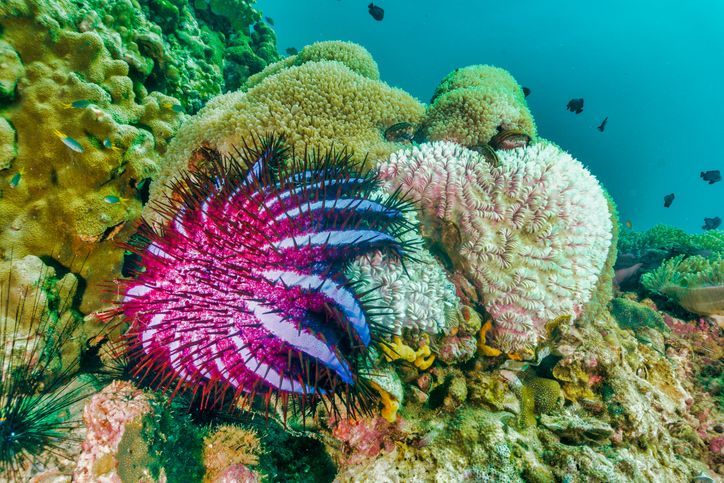
The crown-of-thorns starfish is a native coral predator. In outbreak numbers it becomes one of the biggest threats to the Great Barrier Reef.
Key facts
| Fact | Figure |
|---|---|
| Scientific name | Acanthaster spp. |
| Coral eaten by one adult | Up to 10 m² a year |
| Eggs released by a large female | Over 200 million a year |
| Coral loss on affected reefs during outbreaks | Up to 90 per cent |
| Share of Great Barrier Reef coral loss caused by COTS, 1985–2012 | 42 per cent |
| Outbreaks on the Great Barrier Reef | Recorded since 1962 |
| Adult size | Up to 80 cm across, with up to 21 arms |
| Survival after being cut in half | 75 per cent, with new arms growing within 7 weeks |
| Range | Indo-Pacific reefs, from the Red Sea to the eastern Pacific |
Biological and outbreak figures are from the Australian Institute of Marine Science. The share of coral loss is from De'ath and colleagues' 27-year study of 214 reefs. Program funding is from the Great Barrier Reef Foundation. Full sources are listed at the end of this page.
What is a crown-of-thorns starfish?
The crown-of-thorns starfish (COTS) is a large starfish covered in venomous spines. It lives on coral reefs throughout the Indo-Pacific, from the Red Sea to the west coast of the Americas. Scientists recognise five species of crown-of-thorns starfish, and all five feed on living coral. A sixth member of the genus, the short-spined crown-of-thorns starfish (Acanthaster brevispinus), lives mainly on sandy seafloors. It was long thought not to eat coral, but a 2023 study recorded it feeding on hard corals too. Crown-of-thorns starfish belong to the genus Acanthaster (Acanthaster spp.).
COTS feed on living coral. A starfish pushes its stomach out over the coral, digests the tissue and leaves a white coral skeleton behind. They prefer fast-growing corals such as branching and plate corals, which are also the corals that help reefs recover fastest after bleaching events and other disturbances.
Why outbreaks are so damaging
At normal numbers, crown-of-thorns starfish are part of a healthy reef. The problem is outbreaks, when numbers rise so high that the starfish eat coral faster than it can grow back. Outbreaks can kill up to 90 per cent of the coral on affected reefs, and the damage is comparable to that caused by cyclones.
The Great Barrier Reef has had outbreaks since 1962. Each one has lasted years and spread across large parts of the reef. Outbreaks add to the pressure from marine heatwaves and coral bleaching, because the corals that survive bleaching are then eaten.
A global problem
Crown-of-thorns starfish damage reefs right across the Indo-Pacific. Scientists now recognise five species, each in a different region:
| Species | Region |
|---|---|
| Acanthaster benziei | Red Sea |
| Acanthaster planci | Northern Indian Ocean |
| Acanthaster mauritiensis | Southern Indian Ocean |
| Acanthaster cf. solaris | Western and central Pacific, including the Great Barrier Reef |
| Acanthaster cf. ellisii | Eastern Pacific |
Recorded outbreaks show the scale of the problem:
- Great Barrier Reef, Australia. Coral cover halved between 1985 and 2012, and crown-of-thorns starfish caused 42 per cent of that loss. The study found that without COTS, coral cover would have increased by 0.89 per cent a year, despite cyclones and bleaching.
- Moorea, French Polynesia. During an outbreak that reached the island in 2006, live coral cover at one site fell from 47 per cent to 2 per cent by 2009. Researchers estimated recovery would take 10 to 30 years.
- Saudi Arabia, Red Sea. About one-third of reefs showed degradation from COTS outbreaks between 1998 and 2010.
- Tanzania. Outbreaks affected more than 60 per cent of reefs by 2006.
- Maldives and Japan. Outbreaks have been recorded in the Maldives, and Okinawa in Japan is one of the most studied outbreak regions after the Great Barrier Reef.
Scientists describe COTS outbreaks as a major cause of sustained coral decline across Indo-Pacific reefs, and still one of the major drivers of coral loss alongside mass bleaching.
Read more in our article Crown-of-thorns starfish: why a global reef threat is so hard to stop.
Why COTS are hard to control
- They breed in huge numbers. A large female can release over 200 million eggs a year.
- They regenerate. In one study, three-quarters of starfish cut in half survived, and within 7 weeks their wounds had healed and some were growing new arms.
- The reef is enormous. The Great Barrier Reef covers thousands of individual reefs.
- Culling is manual. Divers find starfish by eye and cull them one at a time.
From pest to resource
Control programs remove tens of thousands of crown-of-thorns starfish from the Great Barrier Reef every year. Today, these starfish have no commercial use.
Leap Biotech's approach is to treat culled starfish as a raw material. The same high reproductive and regenerative capacity that makes COTS hard to control also makes them a renewable source of valuable biomaterials.
This does not replace control programs. It adds value to them, by turning a cost into a product and helping to build a long-term, industry-supported model for reef protection.
Last updated
Working on reef protection, skincare or biomaterials?
We are looking for research partners, reef organisations and investors.