Crown-of-thorns starfish: why a global reef threat is so hard to stop
Crown-of-thorns starfish outbreaks have stripped coral from reefs from the Red Sea to French Polynesia. Here is how bad the problem is, what communities and governments are doing, and why culling alone struggles to keep up.
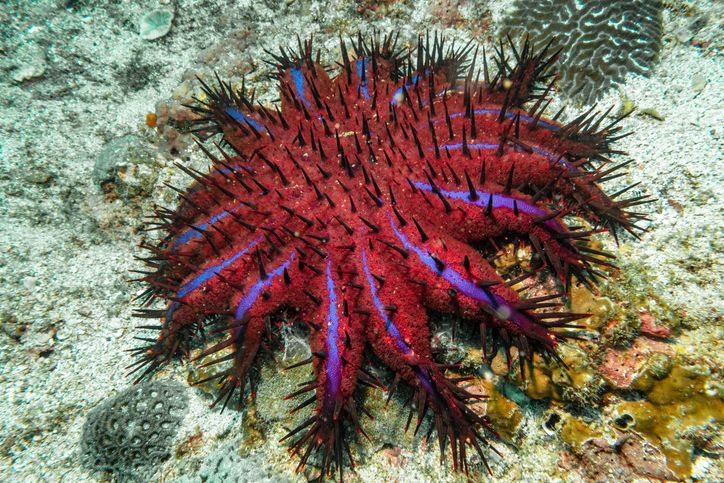
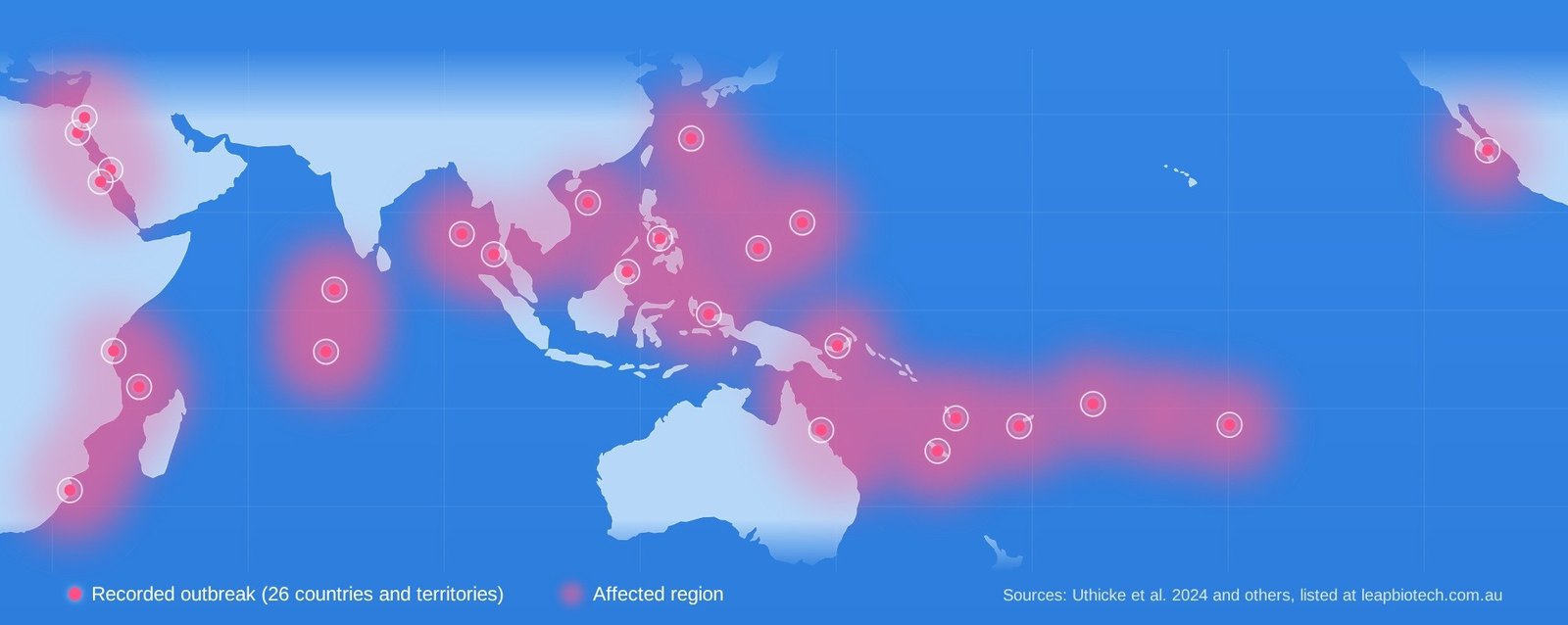
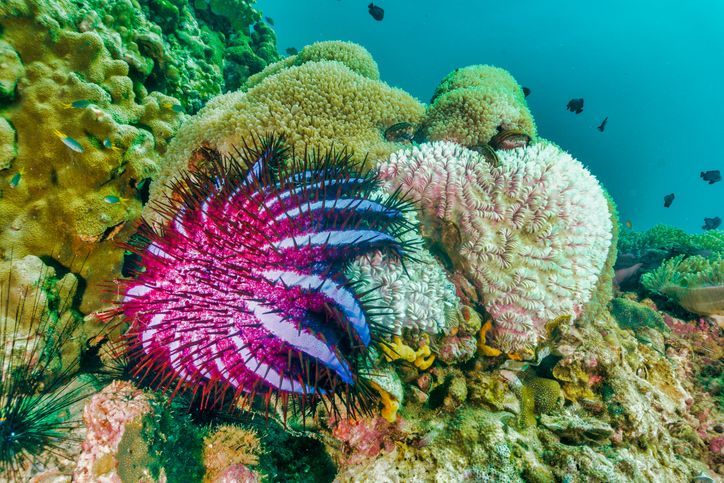
Crown-of-thorns starfish (COTS) are one of the biggest natural threats to coral reefs anywhere in the world. They live on reefs across the Indo-Pacific, from the Red Sea to the eastern Pacific, and in outbreak numbers they can kill up to 90 per cent of the coral on a reef. Communities and governments in many countries have spent decades removing them by hand, yet outbreaks keep returning. The reasons lie in the starfish's biology and in the pressure people put on reefs.
One predator, five species
Crown-of-thorns starfish were once treated as a single species. Scientists now recognise five, each in its own region:
| Species | Region |
|---|---|
| Acanthaster benziei | Red Sea |
| Acanthaster planci | Northern Indian Ocean |
| Acanthaster mauritiensis | Southern Indian Ocean |
| Acanthaster cf. solaris | Western and central Pacific, including the Great Barrier Reef |
| Acanthaster cf. ellisii | Eastern Pacific |
All five feed on living coral, and all five can form outbreaks.
How bad is the problem?
Great Barrier Reef, Australia. A 27-year study of 214 reefs found that coral cover on the Great Barrier Reef halved between 1985 and 2012. Crown-of-thorns starfish caused 42 per cent of that loss, almost as much as cyclones. The researchers calculated that without COTS, coral cover would have grown by 0.89 per cent a year, even with cyclones and bleaching.
Moorea, French Polynesia. An outbreak that reached Moorea in 2006 swept through the island's reefs. At one monitoring site, live coral cover fell from 47 per cent in 2006 to 2 per cent in 2009. Researchers estimated the reef would need 10 to 30 years to recover, if nothing else disturbed it.
Red Sea. About one-third of reefs in Saudi Arabia showed degradation from COTS outbreaks between 1998 and 2010. Outbreaks have also been recorded off Egypt and Sudan.
Tanzania. Outbreaks of the southern Indian Ocean species affected more than 60 per cent of Tanzania's reefs by 2006.
Maldives. Outbreaks have reached densities of 25 starfish per 100 square metres at Ari Atoll.
Japan. Okinawa had a massive outbreak around 1980. More than 1.5 million starfish were removed by hand.
What communities and authorities are doing
Australia runs the world's largest COTS control program. The Great Barrier Reef Foundation's program, delivered with the Great Barrier Reef Marine Park Authority and the Reef and Rainforest Research Centre, has a budget of A$57.8 million. Every day, vessels and more than 100 divers survey reefs and cull starfish. In 2025–26 the program culled 64,879 starfish across 220 reefs.
Japan relied on divers removing starfish by hand during its major outbreaks, and researchers at the Okinawa Institute of Science and Technology now study how ocean currents spread starfish larvae between islands.
The Maldives has drawn on scientists, dive operators and resort guests. In October and November 2015, a program led by the Khaled bin Sultan Living Oceans Foundation removed 7,396 starfish with the help of recreational and local divers.
Vanuatu needed a method that island communities could afford. Ox bile injections were expensive, at about CAD $1,200 to treat 25 starfish. In 2012 researchers working with local communities showed that injecting lime juice kills a starfish within two days. Lime juice is now used on several islands.
Household vinegar became another low-cost option after a 2016 study found a single 25 ml injection killed every starfish within 48 hours. Vinegar does not need the permits and specialist equipment that other methods do.
Why COTS are still a growing problem
They breed in enormous numbers. A single large female can release over 200 million eggs a year. Even a small number of surviving adults can seed the next outbreak.
They regenerate. In one study, three-quarters of starfish cut in half survived. Within 7 weeks their wounds had healed and some were growing new arms. This is why divers must kill starfish with an injection rather than break them apart.
Culling itself can trigger spawning. A 2025 James Cook University study found that male starfish injected during the spawning season often released sperm before they died, so culling at the wrong time could add to the next generation.
People have tipped the balance. Research links outbreaks to nutrient runoff from land, which feeds the plankton that starfish larvae eat, and to overfishing of the reef fish that prey on young starfish. Outbreaks on the Great Barrier Reef since the 1960s have tended to follow extreme floods of the Burdekin River.
Culling is slow and expensive. Every starfish has to be found by eye and injected one at a time, often across thousands of reefs. Once an outbreak takes hold, removal can only protect the most valuable reefs.
A new approach: giving culled starfish a value
Control programs are essential, and they work where they are sustained. But they rely almost entirely on public funding, and the starfish they remove are treated as waste.
Leap Biotech is working on the other side of the problem. We turn culled crown-of-thorns starfish into valuable biomaterials for cosmetics, research and biomedical applications. If a reef pest has commercial value, removing it creates income, local employment and new economic opportunities as well as protecting coral, which can help reef protection stay funded over the long term. Our model is designed to be repeated wherever COTS control programs operate.
Read more about crown-of-thorns starfish or see how our technology works.