Where crown-of-thorns starfish outbreaks have been recorded: 26 countries and territories
A sourced list of the countries and territories where crown-of-thorns starfish outbreaks have damaged coral reefs, from the Red Sea and Indian Ocean to Asia, the Pacific and the eastern Pacific.
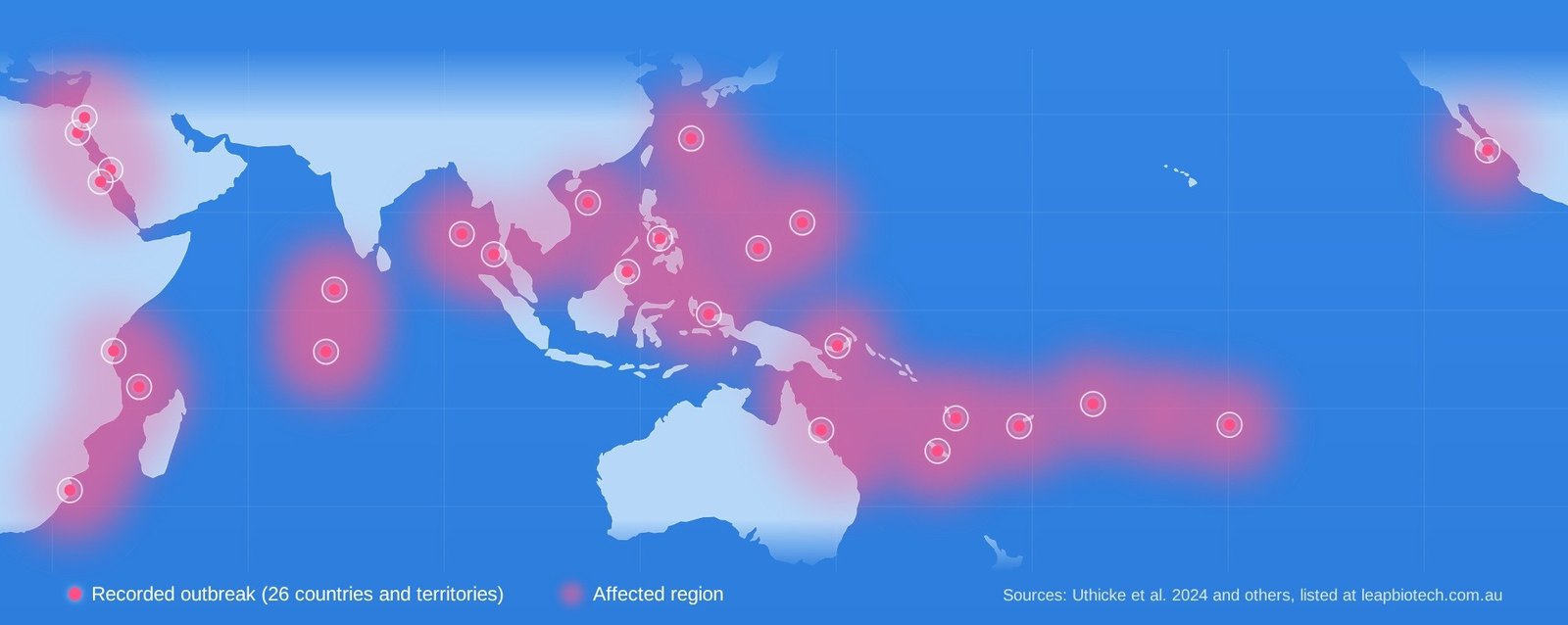
Crown-of-thorns starfish (COTS) outbreaks have been recorded in at least 26 countries and territories: Australia and 25 others across the Red Sea, the Indian Ocean, Asia, the Pacific and the eastern Pacific. This list brings together the published evidence for each one. It is a minimum count, because many reefs are rarely surveyed and outbreaks there go unreported.
The list
| Region | Country or territory | What has been recorded | Source |
|---|---|---|---|
| Pacific | Australia | Coral cover on the Great Barrier Reef halved from 1985 to 2012, and COTS caused 42% of the loss. The control program culled 64,879 starfish in 2025–26. | De'ath et al. 2012; GBRMPA |
| Red Sea | Saudi Arabia | About one-third of reefs between the Farasan Islands and Al Wajh Banks degraded by outbreaks, 1998–2010 | Uthicke et al. 2024 |
| Red Sea | Egypt | Outbreaks documented off Hurghada | Uthicke et al. 2024 |
| Red Sea | Sudan | Aggregations of several hundred starfish within a few hundred metres | Uthicke et al. 2024 |
| Red Sea | Israel | Starfish actively removed from the Eilat Coral Beach Nature Reserve | Uthicke et al. 2024 |
| Indian Ocean | Maldives | Repeated outbreaks; 7,396 starfish removed in two months in 2015 | Uthicke et al. 2024; Living Oceans Foundation |
| Indian Ocean | India | Infestations in the Andaman Islands | Uthicke et al. 2024 |
| Indian Ocean | Tanzania | More than 60% of reefs affected by 2006 | Uthicke et al. 2024 |
| Indian Ocean | Comoros | Outbreaks off Grande Comore as early as 1973 | Uthicke et al. 2024 |
| Indian Ocean | South Africa | Localised outbreak at Sodwana Bay in 1992 | Uthicke et al. 2024 |
| Indian Ocean | Chagos Archipelago | Outbreaks at Danger and Eagle Islands in 2012 | Uthicke et al. 2024 |
| Asia | Japan | More than 1.5 million starfish removed by hand in Okinawa around 1980 | OIST |
| Asia | China | Outbreak in the Xisha Islands, South China Sea | Environmental Research, 2023 |
| Asia | Philippines | Five decades of outbreaks on Philippine reefs | Philippine Journal of Fisheries |
| Asia | Thailand | Infestations in the Andaman Sea | Uthicke et al. 2024 |
| Asia | Malaysia | Rising starfish numbers threatening Sabah's reefs in 2025 | New Straits Times |
| Asia | Indonesia | COTS identified as a major cause of coral death | Baird et al. 2013 |
| Pacific | Papua New Guinea | Major outbreak in Bootless Bay, Central Province | Coral Reefs, 2006 |
| Pacific | Federated States of Micronesia | Outbreak from Pohnpei to Yap in 2009 | Reef Resilience Network |
| Pacific | Guam | Repeated outbreaks on Guam's reefs | Guam Reef Life |
| Pacific | Fiji | Outbreaks recorded in the 1920s and 1940s; still a potential threat | Dumas et al. 2020 |
| Pacific | Vanuatu | Outbreaks confirmed on Santo and Efate, with sightings in six provinces | Dumas et al. 2020 |
| Pacific | New Caledonia | 23 outbreak sites confirmed | Dumas et al. 2020 |
| Pacific | French Polynesia | Live coral cover at one Moorea site fell from 47% to 2%, 2006–2009 | Kayal et al. 2012 |
| Pacific | American Samoa | Ongoing outbreak in the National Park of American Samoa | US National Park Service |
| Eastern Pacific | Mexico | New or recurring outbreaks in Baja California | Uthicke et al. 2024 |
What the list shows
The problem spans two oceans. Outbreaks have been recorded from the Red Sea and the coast of East Africa, across the Indian Ocean and Southeast Asia, and through the Pacific to Mexico. Five different species of crown-of-thorns starfish are involved, and every one of them forms outbreaks.
It is not only a Great Barrier Reef problem. Australia has the most research and the largest control program, but some of the most severe coral losses have been recorded elsewhere, such as Moorea in French Polynesia and Tanzania.
Many small island nations are affected. Fiji, Vanuatu, the Federated States of Micronesia and others rely on reefs for food, tourism and coastal protection, but have far fewer resources for control than Australia.
The true number is higher. Outbreaks have also been reported anecdotally in other places, such as Palau, Samoa, Kenya, Mauritius, Oman, Sri Lanka and Taiwan. We have left these off the list until we find published evidence.
Why it matters for Leap Biotech
Leap Biotech turns culled starfish into valuable biomaterials, creating a commercial return for reef protection and employment and new economic opportunities in local communities. We will operate across Australia and Fiji, and our model is designed to be repeated in any country on this list that runs a control program.
If you know of a published record of an outbreak in a country not listed here, please contact us and we will add it.